Arsenic
Silent SpringArsenic is an ancient, naturally occurring poison that remained in widespread agricultural use even as pesticides shifted after the Second World War toward synthetic organic compounds. The book presents it not as a chemical safely left behind, but as a persistent hazard: used in weed and insect killers, embedded in contaminated soils and waters, and associated with chronic poisoning and cancer in people and other animals. Its history makes visible the slow passage from a chemical’s application to consequences that may emerge far from the point of use and long after exposure begins.
Properties and Uses
Arsenic occurs widely with the ores of various metals and in small amounts in volcanoes, seawater, and spring water. Its relations to people are longstanding and varied. Because many arsenic compounds are tasteless, the substance also has a grim history as a means of homicide. In modern agricultural use, it persisted after the postwar turn away from inorganic pesticides: arsenic remained a basic ingredient in a variety of weed and insect killers. Sodium arsenite was commonly used as a weed killer, while calcium arsenate and other arsenic compounds served as insecticides.
The familiarity of arsenic-based products did not make them harmless. The account warns that careless use founded on a belief in their safety could have disastrous results. Arsenic compounds continued to be used liberally even as laboratories produced a constant stream of newer chemicals. As roadside sprays, they had cost farmers livestock, an immediate reminder that the effects of pesticide use could reach beyond the intended target. More broadly, arsenic-contaminated environments had caused illness and death among horses, cows, goats, pigs, deer, fish, and bees.
Persistence in Land and Water
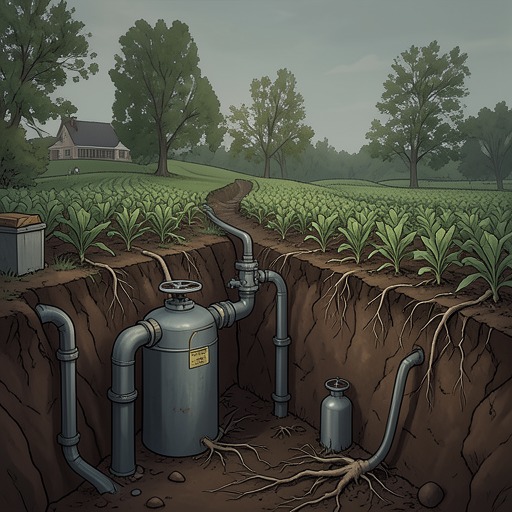
Arsenic illustrates the persistence of soil contamination. Although arsenic sprays on growing tobacco had been largely replaced by synthetic organic insecticides from the mid-1940s, the arsenic content of cigarettes made from American-grown tobacco increased by more than 300 percent between 1932 and 1952. The contrast suggests that ending or reducing one use does not erase what earlier applications have left in the environment. The book calls arsenic a classic case of virtually permanent poisoning of the soil.
Long-term accumulation in the landscape can also become a route into water supplies. The book describes arsenic-drenched soils on tobacco plantations, in many orchards in the Northwest, and on blueberry lands in the East as potential sources of water pollution. It warns that prolonged use of arsenical insecticides could create conditions resembling historic cases of widespread poisoning. The risk is not confined to the field where a product was applied: contaminated soil and water connect agricultural practice to people and animals who encounter the chemical through their surroundings.
Arsenic’s environmental significance predates pesticide use. It was present among the earth’s hostile elements before life arose; arsenic washed from soil or rock could contaminate food and water. The book places this natural background beside contamination caused or intensified by human activity, distinguishing the existence of a hazard from the decisions that expose populations to it. Arsenic therefore belongs to a larger account of environmental carcinogens, in which naturally occurring substances and industrial or agricultural pollution can converge in the same routes of exposure.
Chronic Exposure and Cancer
Arsenic is described as the environmental substance most clearly established as causing cancer in humans. The evidence includes historic cases in which polluted water supplies were associated with widespread cancer. In one case arsenic came from mining slag heaps; in another, from arsenic-bearing rock. These examples make water contamination a public-health problem, not merely a local feature of polluted ground.
The mining town of Reichenstein in Silesia supplies a detailed example. Gold and silver ores had been mined there for almost a thousand years, and arsenic ores for several hundred. Over the centuries, arsenic waste accumulated near the mine shafts; streams descending from the mountains carried it onward, and underground water also became contaminated. Residents developed chronic arsenic poisoning, and tumors were a common accompaniment of the disease. The case had chiefly historical significance by the time the book was written: a quarter-century earlier, new water supplies had been provided, largely eliminating arsenic from the drinking water. The intervention shows that an exposure route could be changed, even after contamination had shaped life in the region over a long period.
In Córdoba Province in Argentina, by contrast, chronic arsenic poisoning accompanied by arsenical skin cancers was endemic because drinking water came from rock formations containing arsenic. Read alongside Reichenstein, the case shows how different sources—mining wastes in one place, arsenic-bearing geology in another—could converge on contaminated water and chronic disease. The book also notes that epidemics of chronic arsenical poisoning affecting whole populations over long periods are on record. Such histories resist the idea that environmental harm must arrive as one dramatic episode: its consequences can accumulate across years of ordinary exposure.
The discussion of cancer places arsenic within a history of environmental carcinogenesis. Soot, together with certain aromatic hydrocarbons, was recognized as cancer-causing nearly two centuries earlier by an English physician; arsenic, meanwhile, was associated historically with cancer in people and animals. The book emphasizes that hazardous exposures can arise from substances already present in the environment as well as from chemicals introduced or dispersed through human activity. The central concern is not simply whether a single dose causes immediate illness, but whether repeated or continuing contact helps produce degenerative disease over time.
Exposure, Accumulation, and Ecological Meaning
The book distinguishes acute poisoning from the broader problem of chronic exposure. A sufficiently large single exposure can precipitate acute poisoning, but the greater concern is often the less conspicuous accumulation of effects. People do not encounter chemicals under the controlled conditions of laboratory animals; they may be exposed to several unrelated substances through soil, water, or the body. This broader account of mixed exposure cautions against treating any one chemical encounter as the whole measure of risk.
The book’s account of pesticide retention offers a related model of how a chemical burden can grow inside a body. DDT, a different pesticide, is stored in fatty tissues and only slowly excreted; even small continuing intakes can accumulate, and small amounts of pesticides retained over time can contribute to chronic poisoning and degenerative changes. These passages do not establish the same specific storage mechanism for arsenic. Their relevance is structural: they show why the book treats exposure as a process shaped by duration, persistence, and the interaction of chemicals, rather than as a question of immediate symptoms alone.
Arsenic thus connects scales that are easy to consider separately: mineral deposits and agricultural formulations, fields and drinking-water sources, local pollution and population-wide illness, animal deaths and human cancer. Its presence in soil and rock is part of the natural world, but mining, spraying, and other forms of human activity can redistribute it into routes of exposure. In the book’s argument, the decisive issue is the vulnerability created when a persistent hazard moves through an interconnected environment and the consequences become visible only over time.